When Is Samhain? The Date, Irish Sources & Divination
Oct 02, 2026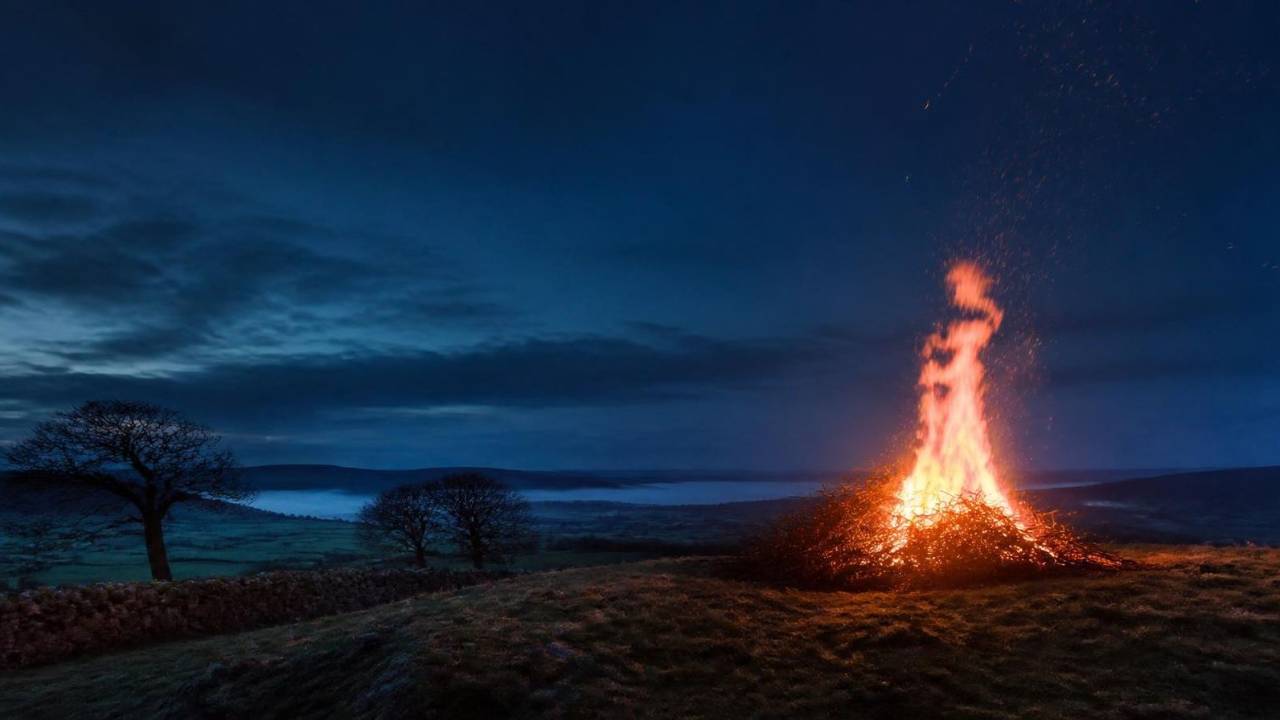
Samhain Eve begins on the night of the 31st of October, which is of course the evening before the 1st of November. It marks the first day of winter in the Irish traditional year, a cycle marked by the four Fire Festivals.
Some people though, keep the festival on the astronomical cross quarter day, which falls around the 7th of November, and both dates have a case to be made for them, being honest.
We'll discuss the exact dates a little further down, once we get our bearings a bit better with this traditional Irish holiday.
➡️ Free Gift: Download your free Samhain Cheat Sheet Here.
What is Samhain?
Samhain, pronounced Sow-in (sow as in cow), is often said to be the first of the four fire festivals of the Irish year. Kevin Danaher opens the Samhain chapter of his classic folklore book, 'The Year in Ireland', with:
"The ancient festival of Samhain, the first day of Winter is traditionally kept on 1 November."
He describes its eve, Oíche Shamhna, being celebrated all over Ireland with feasting, merrymaking and divination.
It was a working deadline though, as much as a feast or a party. Known as the end of the farmer's year, this was the date by which the corn, hay, potatoes, turnips and apples had to be harvested and stored, the cattle and sheep brought down from the far mountain pastures, and the turf and wood gathered in for the winter fires.
Money moved at the same time, because "Everyone has debts at Hallow E'en" as the Irish proverb says, so wages were paid, rents were paid and the hire of conacre land was all settled by Samhain.
You'll know the night nowadays as Halloween, and the two share a date, though as I mentioned above there's plenty of debate about exactly when we should be celebrating Samhain.
When is the true date of Samhain?
The folk record keeps Samhain on the 1st of November, with the festival starting on its eve. Others argue for the astronomical cross quarter day, which moves a little every year.
Ronald Hicks, writing in the journal Archaeoastronomy in 1985, says the Irish quarter days:
"would certainly not have fallen so neatly at the beginnings of the months in pre-Christian times".
To work out the cross quarter date for yourself, you'd have to find the exact midpoint between the autumn equinox and the winter solstice, which seems like a lot of faff to me personally but I know some folk are very keen to get it right.
Look up the exact date and time of both for your own location and time zone, count the time between them, halve it, and add that to the moment of the equinox.
Example: For 2026, the September equinox fell at five past midnight UTC on the 23rd of September and the December solstice lands at ten to nine in the evening UTC on the 21st of December, so the midpoint comes out late on the evening of Friday the 6th of November, Irish time.
My own practice runs wider than any single date. Working at Cruachán over the years, I found the Samhain magic there certainly wasn't confined to the 31st of October, and that the whole season from dark moon to dark moon around that date really carries it.
Is it wrong to celebrate Samhain on the 31st of October?
No, it's not wrong. Sure make an informed choice based on the Irish sources and your own circumstances, whether that's the calendar date, the cross quarter day, or the whole season between the dark moons.
At the end of the day, Samhain is also the Irish language name for the whole month of November, so as far as your personal spiritual practice goes, celebrate it on the eve or during the month, whenever suits your own life.
I also made a whole video on whether Samhain falls on the 31st of October or on the 7th of November, the astronomical cross quarter day, and how to pronounce it.
➡️ WATCH THE VIDEO HERE: WHAT DATE IS SAMHAIN?
Is there an ancient tradition of Samhain in Ireland?
Some people are still trying to say there's no ancient tradition of Samhain in Ireland, which is definitely not the case. In certain corners of academia, the anti-nativist bias holds a very strong sway though, and they do get their air time quite regularly.
While looking at mythological sources, author Morgan Daimler, who also teaches with us here at the Irish Pagan School, put together a list of the early Irish tales and texts that mention Samhain, including (but not limited to) the Wooing of Emer, Lebor Gabála Érenn, the Battle of Mag Mucrama, the Battle of Crimna, the Birth of Aedh Slaine, and Echtra Nerai.
The Wooing of Emer even sets out the two halves of the year that put Samhain where it is:
"55. Bend Suain, son of Rosc Mele, which she said this is the same thing, viz., that I shall fight without harm to myself from Samuin, i.e., the end of summer. For two divisions were formerly on the year, viz., summer from Beltaine (the first of May), and winter from Samuin to Beltaine."
In Echtra Nerai, the Adventure of Nera, the woman Nera has married inside the síd (fairy mound) tells him:
"This warband can do nothing for a year, until the next Samain",
and that
"They will come again next Samain night, for the síde of Ireland are always open at Samain."
That's John Carey's translation, in John Koch's anthology 'The Celtic Heroic Age'.
Look, just stop being weird will yiz? Let people have nice things, if it's not harming anyone.
Who comes visiting at Samhain?
The folk record is full of the night's visitors, and you'd want a strong stomach and a stout heart to be out and about an Irish country lane on Samhain eve.
Danaher writes that nobody would really be surprised that night to meet the Púca, the Black Pig or the headless dallachan, or to wake and find the returned dead of the family seated around the kitchen hearth.
He's careful to add that most people regarded the night of the 2nd of November, All Souls' Day, as the time the dead visited and were prayed for, rather than Hallow E'en itself. A family that keeps its remembrance a couple of nights after Samhain is keeping a date the record supports.
What is the connection between Samhain and the Pleiades?
Morgan Daimler teaches a full class on the Pleiades, their link to Samhain and their place in the fairy faith, at the Irish Pagan School. It's called The Pleiades: Online Class exploring the Significance of the Stars in Ireland, and Globally.
➡️ Access the Online Class Here
How to do traditional Irish Samhain divination
Divination and fortune telling belongs to this night, because everything is changing and shifting, and Danaher's own judgement is that Hallow E'en:
"was above all others the proper season for such activities".
Two charms from his folklore collecting and indeed, the whole corpus of Irish folklore - the apple peeled in one long strip and dropped on the ground to form the initials of the future husband, and the apple eaten before a mirror so that his face is seen looking over the girl's shoulder.
Apples for divination is a tradition and belief that would seem to be older than just the time our relateively recent folklore was collected, a couple of hundred years ago, because Irish mythology is full of apples associated with the Irish Otherworld.
The folk record though gives both as marriage charms, and I'm giving them to ye below, adapted for any question you're carrying into the winter.
Danaher also says there's "an uncomfortable sense of dabbling with unseen and potentially malevolent powers" in all these charms. He quotes Lady Wilde's story of a servant who played the mirror trick "in the name of the devil" and was found dead in front of the looking glass the next night, so do go in with respect and don't be acting the maggot with all this.
Samhain night is for looking ahead into the dark half of the year, so this working is for one question you want answered before the winter sets in. Do it on your own, late in the evening, around midnight on Samhain Eve if you can (but as we've seen, don't be worrying too much about exact timing), in a room where nobody will walk in on you. Or won't freak out, at least, if they do.
You'll need a fresh apple, a hand mirror, a candle, and a small knife, with a black handle if you have one but any knife will do ya.
- Light the candle and set it on the table, then turn off the other lights, so the flame and the mirror are the only things holding your attention.
- Hold the apple and the mirror for a moment and take a few slow breaths to settle yourself, because a settled head makes it easier to tell your own wishing apart from what comes back to you.
- Peel the apple with the knife, trying to keep the peel in one long strip, and keep your question in your mind the whole time you're peeling. Danaher records the black handled iron knife as a charm against fairies and other uncanny visitors, which is the reason to use one here if it's in your kitchen drawer.
- Hold the mirror up so it catches the candlelight and look into it, asking your question out loud or in your head. Notice whatever comes, a face, a shape or a feeling, and don't be trying to force anything.
- Drop the apple peel over your left shoulder, then turn and look at the shape it's made on the floor, since it may form a letter, an initial or a symbol connected to your question.
- Thank whoever you felt was with you, your own dead included, and put out the candle.
- Before you sleep, write down what you saw in the mirror and the shape the peel made. These are your divinatory symbols, and they can take a while to make sense.
Come back to those notes over the next few weeks. When one of them starts to make sense, act on it in your ordinary life, whether that's sending the email, making the phone call or starting the conversation it pointed you towards.
Where can you learn more about Samhain?
The free Samhain Cheat Sheet goes further into the festival, and it's built from my online class Samhain in Ireland, so it'll help you ground your practice in Irish customs and traditions.
🍎 Your Online Class 'Samhain in Ireland' is Here
🍎 Your Free Samhain Cheat Sheet Is Here
Slán go fóill, and have a blessed Samhain season.
🍎🍎🍎
Stay connected with news and updates!
Join our mailing list to receive the latest news and updates from our team.
Don't worry, your information will not be shared.
We hate SPAM. We will never sell your information, for any reason.